Two Noses, Two Different Problems
What two rhinoplasty cases show about why the operation is never the same twice
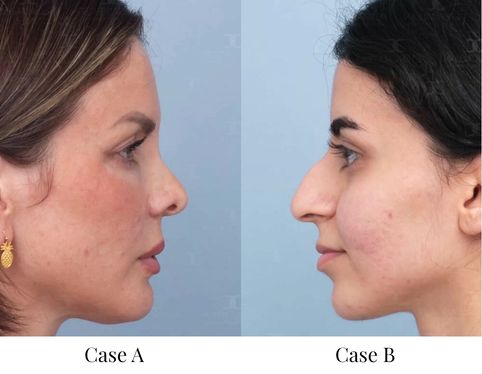
Rhinoplasty isn't one operation. It's a category covering very different problems, and what happens inside it is determined by the structure of the individual nose. Sometimes it is also shaped by what an earlier operation left behind.
What people mean when they say “rhinoplasty”
When someone says they’re considering rhinoplasty, they could be describing any of a dozen concerns. A bump on the bridge. A tip that sits low. A nose that has never allowed easy breathing. A result from previous surgery that didn’t turn out as hoped.
These are different problems. They sit in different parts of the nasal structure and they call for different surgical decisions.
The first case: a revision
This patient had undergone nasal surgery previously and presented with both structural and functional concerns: a hanging columella, retracted alae and a scooped dorsum, alongside significant difficulty breathing. Surgery aimed to restore greater structural balance while addressing the function of the nose.
In simple terms, too much had been taken away. The bridge had dished inward, the nostril rims had pulled up, the centre had dropped down, and the nose had lost the internal support that keeps the airway open.
Revision work carries considerations a first operation doesn’t. Scar tissue and altered anatomy change both what is found and what is possible. Planning focuses on careful assessment of nasal structure, support and function, with decisions guided by what is safe and achievable in the revision setting.
Case A: revision rhinoplasty, before and three months after surgery.
The second case: a dorsal hump
This patient’s concern is one of the most commonly raised in consultation, a bump on the bridge of the nose. A dorsal hump can be made up of both bone and cartilage, and its appearance varies with the individual structure of the nose.
During surgery the nasal framework can be carefully reshaped to alter the profile, while maintaining appropriate structural support and considering the proportions of the face as a whole. Reshaping a framework is not the same as removing something from a surface.
Case B: dorsal hump and tip, before and two years after surgery.
What the two have in common
Assessment. In both cases the work began with structure, support and function, before any decision about what to change. That same assessment is what determines whether an operation is appropriate at all.
Why the two cases can’t be read side by side
One is shown three months after surgery. The other, two years. A nose continues to refine over a long period, so images taken at different points are showing different things. Reading them as though they represent the same stage would be misleading.
If you’re considering rhinoplasty
The most useful thing to bring to a consultation is the concern, not the operation. What is appropriate, if anything is, depends on what the assessment finds. As with any surgery, the risks are discussed in full before any decision is made.
Dr Peter Callan, Specialist Plastic Surgeon. MED0001116292
Schedule your consultation
If you’d like to discuss whether rhinoplasty is right for you, book a consultation with Dr Peter Callan.
Frequently Asked Questions
Is revision rhinoplasty more complex than a first operation?
It can be. Scar tissue and anatomy altered by previous surgery change what’s found during the operation and what can safely be achieved.
Can rhinoplasty address breathing as well as appearance?
Structure and function are assessed together. Whether both can be addressed in a given case depends on what’s found at assessment.
Why are results shown at different times after surgery?
Because a nose keeps refining. A case shown at three months and a case shown at two years aren’t representing the same stage.
Do I need a referral to see Dr Callan?
Yes. A referral from your GP is needed before your consultation.